San Mateo Eichlers / 19th Avenue Park
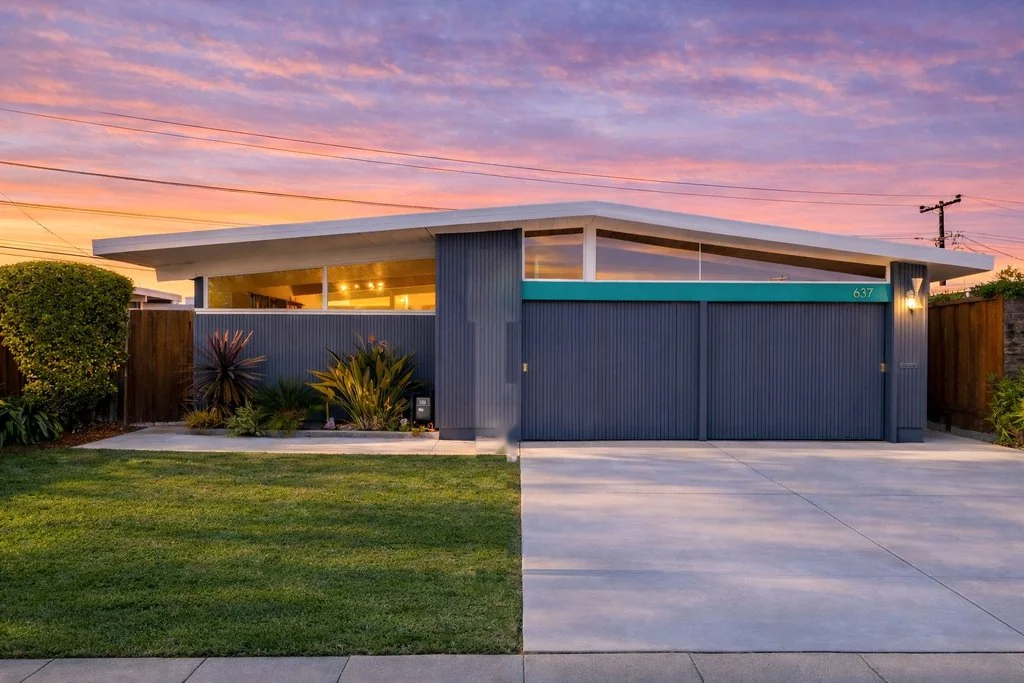
City of San Mateo · 94402 · 1953–1955
19th Avenue Park.
Two years older than the Highlands, four hundred feet lower, and written about almost nowhere. Around two hundred Jones & Emmons houses on small lots, two blocks from a Caltrain platform, finished before Eichler had invented the atrium.
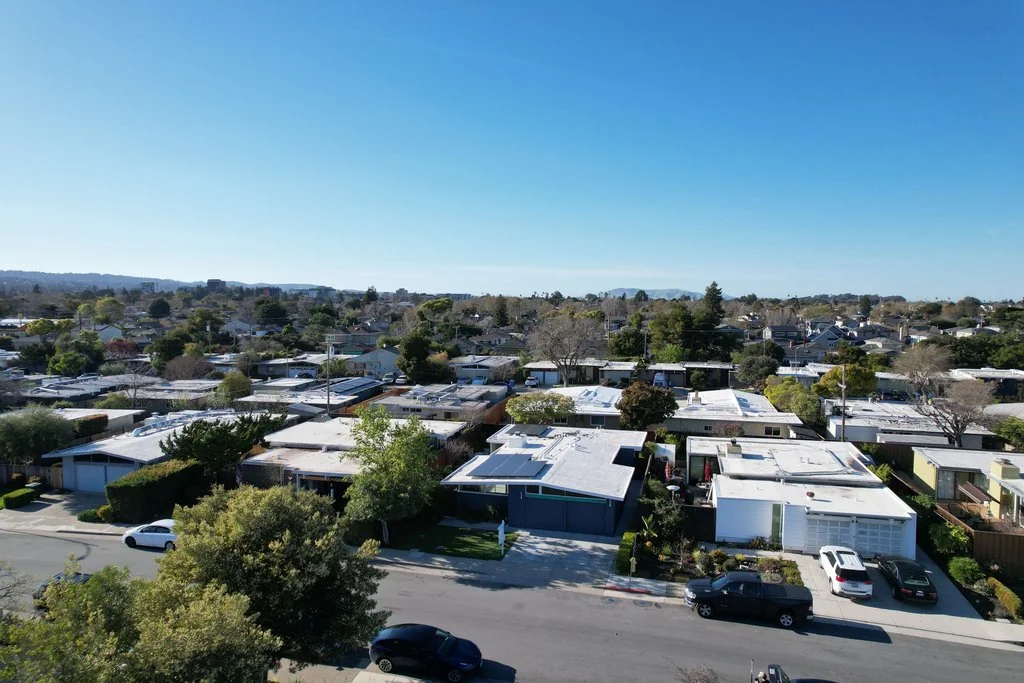
637 Vanessa Drive · Boyenga Team photography
The tract, in one house
Small, early, and much better than its reputation.
Eichler Network calls this a hidden enclave — less known, less esteemed and less costly than Palo Alto, Sunnyvale or the Highlands, and humbler than his later work. That is fair as history and increasingly unfair as a description of what is actually on these streets now.
637 Vanessa Drive, on this page, is a well-kept example: the low gable with its deep overhang, the clerestory band under the ridge, vertical board siding, and a teal panel over the garage doing all the colour work on the elevation.
- Built
- 1953–1955
- Architects
- Jones & Emmons
- Homes
- ~235 (eichlerforsale) or ~240 (Eichler Network); "over 200" elsewhere
- Plans
- Three basic floor plans
- Jurisdiction
- City of San Mateo — inside city limits
- Bounded by
- S. Delaware Street / Concar Drive / S. Grant Street
- Transit
- Hayward Park Caltrain, two blocks
- Schools
- Sunnybrae Elementary → Borel Middle → Aragon High
The streets
Eight streets and two ways in.
Joanne Drive, Wolfe Drive, Connie Avenue, Eleanor Drive, Edna Way, Jody Court, Celeste Drive and Vanessa Drive, plus homes on the west side of S. Grant Street near Haddon Drive. Access is from Charles Lane off S. Delaware Street and Betty Lane from S. Grant Street.
The tract drawn, with the two access lanes →
The naming is a period tell in its own right — women's first names, of the sort tract developers used across the early fifties, and a world away from the Revolutionary-War theme Eichler would choose for the Highlands two years later.
What the houses are
Three basic floor plans; modest three- and four-bedroom homes on lots in the neighbourhood of 4,900 to 5,900 square feet. Roofs are described as a mix of flat roofs, low-gabled models, and shed-roof and flat-top combinations. Post-and-beam construction and radiant slab heat, as everywhere Eichler built.
Chronology
This tract predates the atrium entirely.
Eichler's atrium was introduced and marketed in 1957–58, credited to Bob Anshen. 19th Avenue Park was finished in 1955. The arithmetic is not subtle.
You will nonetheless find a neighbourhood description online claiming these homes have "central atria." We think that is generic Eichler boilerplate applied without checking the build dates, and we would not rely on it. Neither of the two sources that actually cover this tract in detail mentions atriums.
What you get instead is the earlier Eichler idea: glass to the rear garden rather than to an interior court, a plan organised around a private back yard, and the street face closed. If you are shopping for an atrium in San Mateo, you are shopping in the Highlands, and in the Highlands you are shopping from about 1958 on.
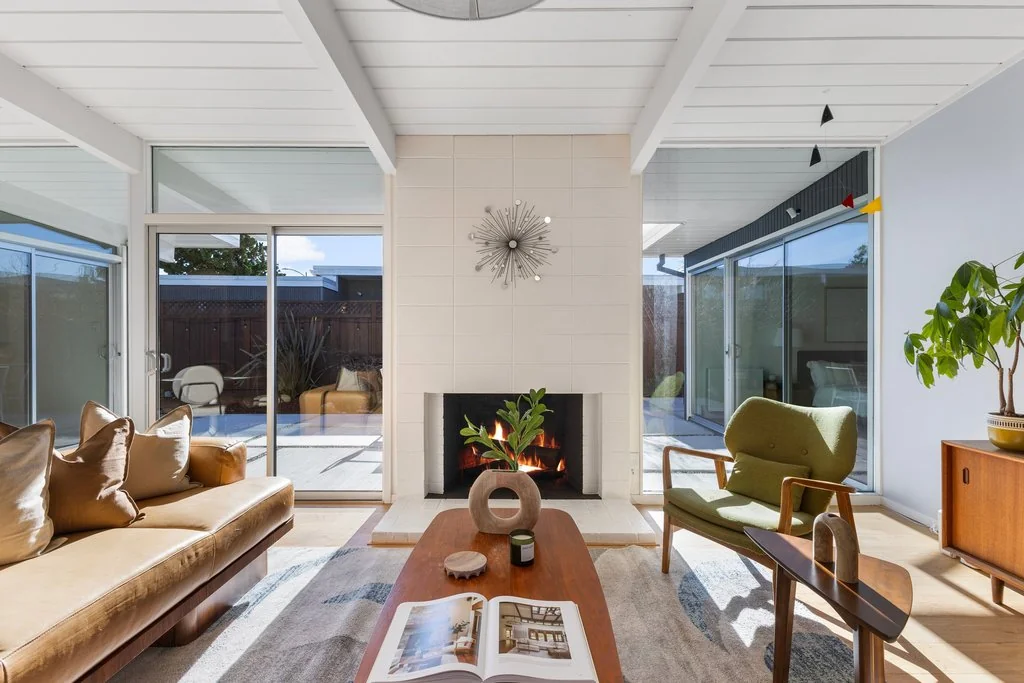
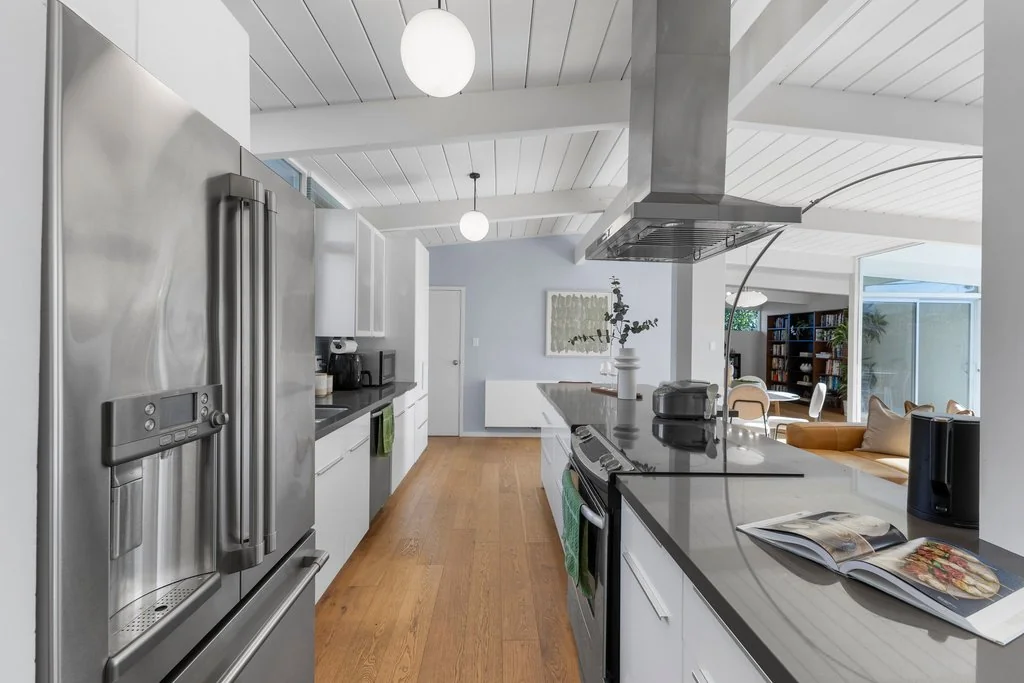
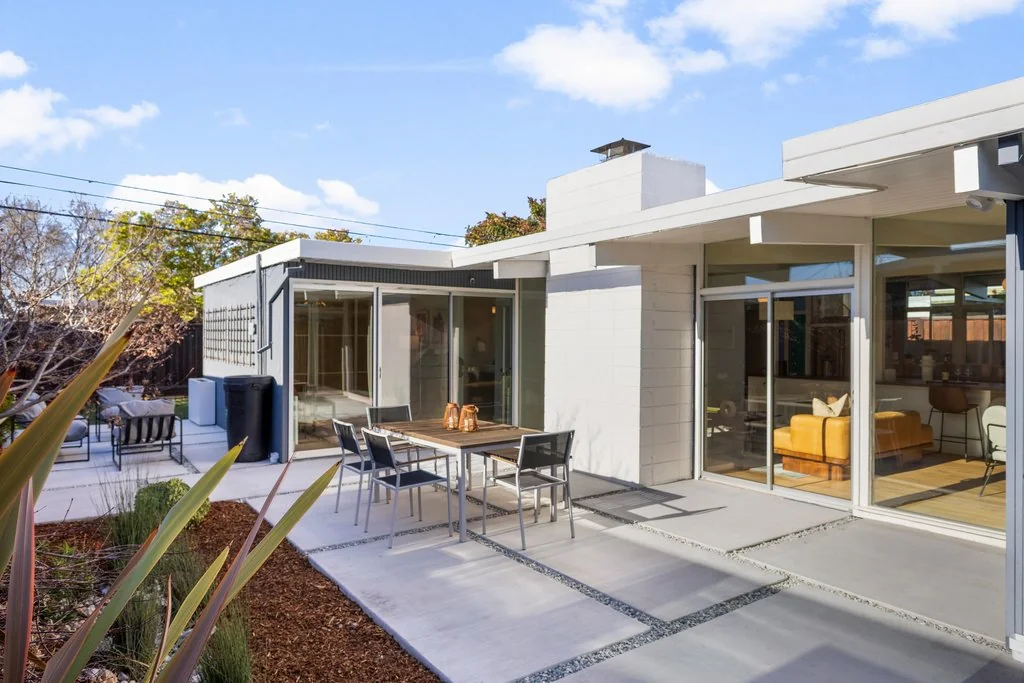
637 Vanessa Drive — a renovated house, so read these as the plan and the frame rather than as original finishes. Boyenga Team photography.
History
The part of this neighbourhood's story that almost nobody tells.
Eichler Network's account of 19th Avenue Park records two things about its first residents that set it apart from every other Eichler tract on the Peninsula. It "began partly as a blue-collar community" — unusual in itself for Eichler, whose buyers were typically professional. And it had, in Eichler Network's words, "an unusually large percentage of Asian residents — during a time when few neighbourhoods in the area would sell to Asians."
That is worth stating plainly rather than leaving as colour. In the early 1950s, racially restrictive practice was the norm across Peninsula subdivisions. Joseph Eichler's refusal to discriminate is a well-documented part of his record, and 19th Avenue Park is one of the places where it is visible in who actually bought the houses.
We have not been able to find period newspaper coverage or sales records that would let us put numbers to it. That gap is real and we would like to close it — the San Mateo County Historical Association holds San Mateo Times photographic collections, and period city directories, which is where we would look next.
Single-sourced to Eichler Network's tract history. Quoted rather than paraphrased so you can weigh it as we do. On our open list.
Today
A mixed bag, and moving.
Eichler Network describes the tract's condition today as "a mixed bag," with evidence of what one neighbour calls "a period of ticky-tackiness" — the aluminium windows, the stucco-over, the porch that was never there — alongside recent, careful restorations. Both are on the same streets, sometimes next door to each other.
For a buyer that is not a warning so much as a map. An intact original here is a genuinely scarce thing, and a heavily altered one is a different product at a different price. The gap between the two is wider in this tract than in the Highlands, because the base price is lower and the cost to put a house back is the same everywhere.
The location argument
Two blocks to Hayward Park Caltrain. Immediate access to Concar Drive and the 19th Avenue corridor; Hillsdale Shopping Center is close. For anyone commuting by rail rather than by car, this is the best-located Eichler tract in San Mateo County by a wide margin — and the Highlands, on its ridge, is the worst.
The only published median we could find for this tract is $1.92 million as of March 2026, in a range of roughly $1.4M to $3M. That comes from one source, and we have not independently confirmed it.
If it is right, the Highlands carries roughly a 40% premium over 19th Avenue Park. That is a striking finding and exactly the sort of number that gets repeated once someone publishes it, so we are labelling it rather than asserting it.
We are building an Eichler-only rolling twelve-month series for this tract the same way we did for the Highlands. Until it has enough sales to mean anything, this box stays a caveat. Our method →
- vs the Highlands
- Two years earlier, roughly a third the size, smaller lots, smaller houses, flat rather than hillside, city rather than county
- Lot sizes
- Roughly 4,900–5,900 sq ft
- Roofs
- Flat, low-gabled, and shed/flat-top combinations
- Atriums
- Predates them. Treat any claim otherwise with suspicion.
Talk to us
We know this tract better than most.
It is small, it is under-documented, and it turns over rarely — which means getting the right read on a house here is mostly about knowing what has actually traded and in what condition. Tell us the street.