San Mateo Eichlers / Peninsula comparison
Structure first, price second
Biggest tract. Least protection.
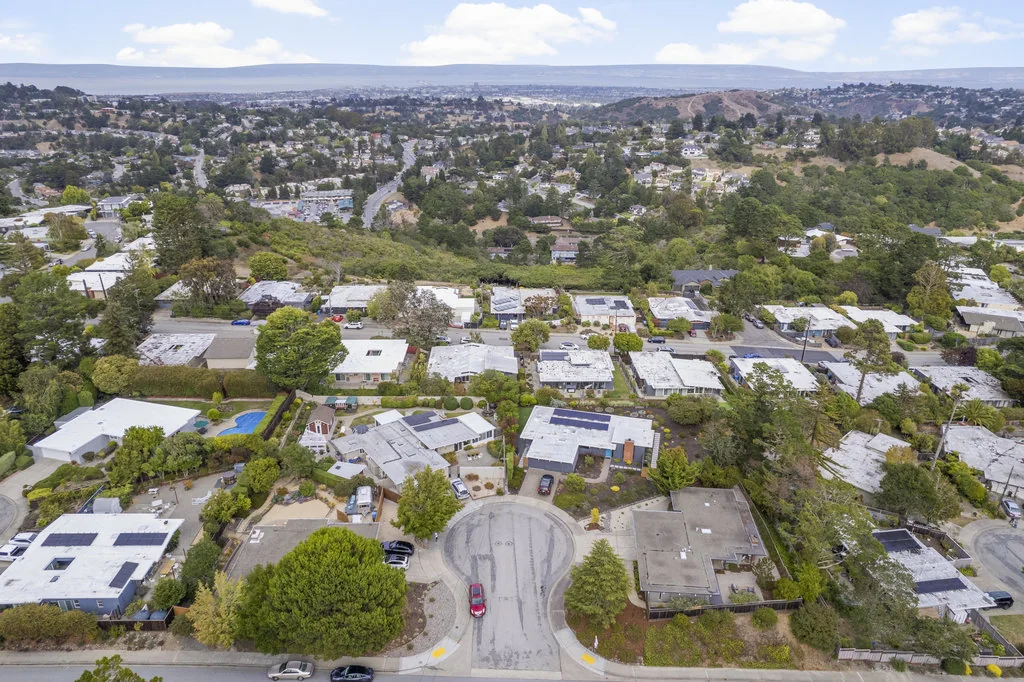
San Mateo's position among Eichler markets is unusual in a specific way: it holds the single largest tract Eichler ever built, and it has less regulatory protection over that tract than almost any comparable market. Those two facts are related, and together they explain more about pricing here than any percentage we could quote.
| Market | Eichlers |
|---|---|
| Palo Alto | ~2,700, across 32 tracts |
| Marin County | 1,700+ |
| Sunnyvale | ~1,100 |
| San Jose | 1,000+ (largest single tract: Fairglen, ~250) |
| San Mateo | 650+ — the largest of which is one contiguous tract |
The comparison that matters
San Mateo Highlands against Palo Alto.
| San Mateo Highlands | Palo Alto | |
|---|---|---|
| Shape of the market | One contiguous tract of ~650–700+ | ~2,700 across 32 separate tracts |
| Jurisdiction | Unincorporated San Mateo County | City of Palo Alto |
| Single-storey overlay | None | SSO zoning overlapping roughly 9–11 Eichler tracts |
| Design guidelines | None | Adopted 2 April 2018, 7–1. Explicitly advisory, not regulatory. Cover 32 tracts. |
| Historic districts | None | Greenmeadow and Green Gables are NRHP districts |
| Individually listed | The X-100, NRHP 2016 | — |
| Second storeys | ~55–60 added; 70+ homes drastically changed | Constrained by the overlay where it applies |
| Terrain | Hillside, ~469 ft, protected watershed on three sides | Flat valley floor |
Reading the table
Protection and price move together in Eichler markets, and not only because protected tracts are in expensive cities. An overlay is a promise about what the street will look like in twenty years, and buyers pay for promises. The Highlands offers the larger and more coherent tract, the better views, and no such promise.
The corollary is the opportunity: latitude to alter a house here that simply does not exist in Palo Alto's protected tracts. Whether that is worth more or less to you is a real question with no general answer, which is why we lay out the structure rather than pronouncing on it.
We are frequently asked what the discount to Palo Alto is. We are not printing a number here yet, because doing it properly means matching cohorts — Eichler-era only on both sides, comparable condition, comparable size, same window — and we have that built for the Highlands and not yet for a Palo Alto comparison tract.
What we can say with confidence: the Highlands trades at a material discount per square foot to the strongest Palo Alto Eichler tracts, and the gap is wider than the difference in the houses. When we have the matched-cohort figure, it will appear here with both samples shown. [Matched Palo Alto cohort — in progress]
And within San Mateo County
The rest of the county's Eichlers are in other cities.
San Mateo has exactly two Eichler tracts — the Highlands and 19th Avenue Park. Baywood has none, despite how often it is listed; it appears in the sources only as an adjacent unincorporated place and as a market comparison, never as an Eichler tract. The county's other Eichlers are in Redwood City, Burlingame, Foster City, Hillsborough, Menlo Park and Portola Valley — different cities, different governments, different markets.
Redwood City
Atherwood, Fairwood and Sequoia Meadow — plus the only Eichler duplexes ever built, all on one street.
San Mateo CountyMenlo Park
Small, early and highly sought, on the Santa Clara County line.
Santa Clara CountyPalo Alto
The largest Eichler city — about 2,700 homes across 32 tracts, with the overlay and the guidelines this page keeps referring to.
Talk to us
Deciding between markets?
We work all of them, which means we can tell you what your money actually buys in each — and where the structural differences bite. It is a better conversation than a price-per-square-foot table.