San Mateo Eichlers / Preservation status
What protects the tract
Nothing does.
There is no single-storey overlay. There are no design guidelines. There is no historic district. The CC&Rs have not been used for architectural control in at least thirty years, and the two neighbourhood bodies are a recreation district and a voluntary association, neither of which reviews plans. One house in the tract is designated, and it is designated individually.
Single-storey overlay
None
Palo Alto has one across roughly 9–11 Eichler tracts
Design guidelines
None
Palo Alto adopted them 2 April 2018, 7–1
Historic districts
None
Greenmeadow and Green Gables in Palo Alto are NRHP districts
Designated buildings
1
The X-100, individually, NRHP 2016
The visible result
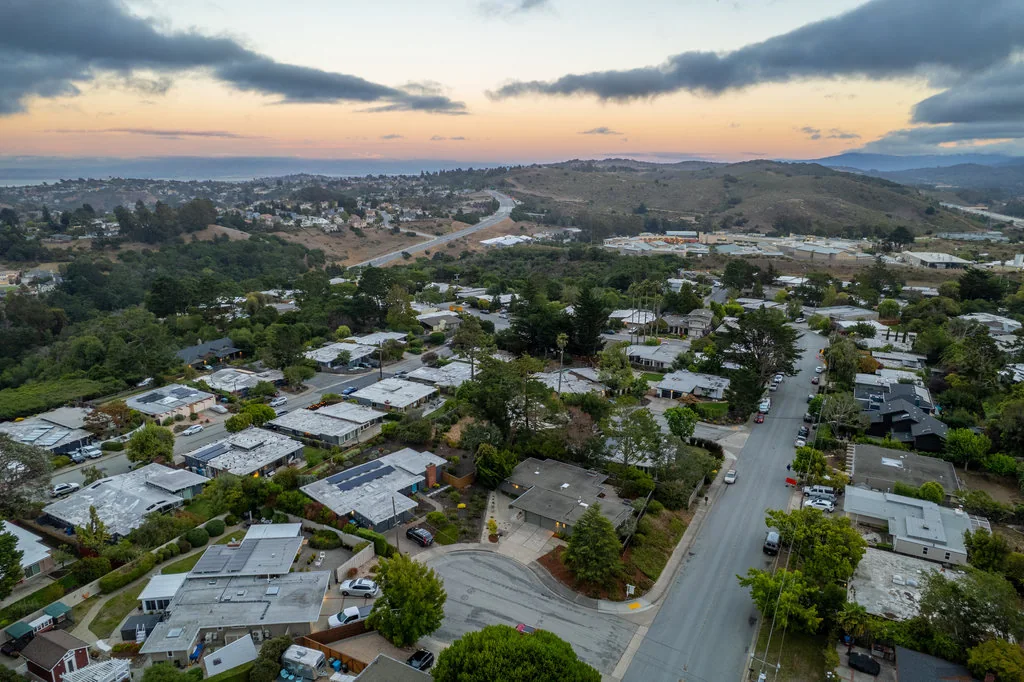
Seventy-plus houses, changed past recognition.
Eichler Network's account of the tract counts more than seventy homes "drastically changed" and around sixty with full, partial or attic second storeys. Wikipedia gives fifty-five second-storey additions. Those are probably overlapping categories counted slightly differently rather than a real conflict — but either way, on a tract of six or seven hundred homes, something on the order of one house in ten no longer reads as an Eichler from the street.
A 14-foot height limitation was floated among other options in a neighbourhood survey a few years before Eichler Network's account, and it did not gain enough momentum to go anywhere.
San Mateo County does have machinery for this: a Historic Resources Ordinance (Article 8) and a Historic Resources Advisory Board. Neither has been applied to this tract.
What this means if you are buying
Two things, and they point in opposite directions, which is why we would rather you weighed them than had us tell you which one wins.
You have latitude. If you want to add square footage, go up, or make a significant change, the constraint here is County zoning — not a design review board, not a single-storey overlay, and not a neighbour with a CC&R enforcement right. In Palo Alto's protected tracts, that is simply not available.
So does everybody else. The house next door has the same latitude, and roughly sixty owners have already used it. On a hillside tract, a second storey next door is not only a massing question — it is a view and privacy question. If you are paying for a Crystal Springs view, look hard at what is uphill of you and what could be built there.
What this means if you are selling
Original condition is scarcer here than in a protected tract, and scarcity is priceable — but only if it is documented and marketed as such. A genuinely intact Highlands Eichler is competing against a lot of houses that look superficially similar in photographs. That is a marketing problem with a solution.
| Highlands | Palo Alto | |
|---|---|---|
| Jurisdiction | Unincorporated county | City of Palo Alto |
| Single-storey overlay | None | SSO zoning across roughly 9–11 Eichler tracts |
| Design guidelines | None | Eichler Neighborhood Design Guidelines, adopted 2 April 2018, 7–1; explicitly voluntary; cover 32 tracts |
| Historic districts | None | Greenmeadow and Green Gables are NRHP districts |
| Individually listed | The X-100 | — |
They are advisory, not regulatory — the document says so itself, and says they "do not, in any way, affect Single Story Overlay (SSO) zoning." The binding instrument in Palo Alto is the overlay. Do not let anyone tell you the guidelines are what stops a second storey there; the zoning is.
Mechanically, yes — the County ordinance and the advisory board exist. Politically it would require a neighbourhood campaign that has already been tried in a softer form and stalled, in a tract where about sixty owners have already built the thing an overlay would prohibit. We would not price a house on the assumption that it is coming.
Talk to us
Worried about what can go up next door?
We will look at the uphill parcels, the County zoning, what has already been approved nearby and what the sightlines actually do. It is the question most buyers here should be asking and almost none do.